
Integrations
Connect external systems as Project sources and Workflow actions.
Integrations let Clearly AI authenticate to external systems and turn their records into usable context or automation targets.
Use integrations to:
- Add tickets, code, documents, assets, and web content as Project sources for Reviews and Chat.
- Trigger Workflows from external events, such as Jira, Linear, Azure DevOps, GitHub, and ServiceNow updates.
- Send Review output back to the tools your team already uses, such as comments, tickets, attachments, Slack messages, SharePoint files, and OneTrust assessments.
Issue trackers
Connect ticketing and work management systems.
Documents
Connect document and knowledge sources.
Code repositories
Connect repositories used as Project context.
Communication
Connect messaging tools.
OneTrust
Read OneTrust assets and publish Review answers to OneTrust assessments.
Snyk
Import Snyk vulnerability and code-security findings as Clearly AI project sources.
Wiz
Import Wiz Projects and posture findings as Clearly project sources.
How integrations work
Each integration is built around external entities, such as a Jira issue, Linear issue, Azure DevOps branch, SharePoint file, or OneTrust asset. When you add one of those entities to a Project, Clearly AI calls the right fetch endpoint and stores the fetched content as a source.
The same entity model powers Workflows. A trigger can emit an entity, such as a Linear issue or Azure DevOps work item, and later steps can comment on it, assign it, attach a Review export, or use it as Project context.
Auth patterns
Clearly AI integrations use one of these authentication patterns.
- OAuth 2.0: User-authorized access through the provider's consent flow. Choose this by default when it is available.
- Client credentials: Service-account or machine-to-machine access. Use this when the integration should act as an application or service account.
- Personal Token: A token you create in the provider and paste into Clearly AI. Use this when OAuth 2.0 is unavailable or when your team wants to manage token rotation directly.
Credential scope in Clearly AI
On the Integrations page, use the Shared (Workspace) and Personal (User) tabs to choose who can use an OAuth 2.0 credential:
- Personal (User): only you can use it
- Shared (Workspace): anyone in your Clearly AI organization can use it
Use Personal (User) for personal access. Use Shared (Workspace) for shared access.
Warning: Shared (Workspace) credentials are shared by every Clearly AI user in your tenant. Use them for system accounts, shared service accounts, or centrally managed integrations.
Scope support depends on the integration and auth flow. For example, GitHub OAuth 2.0 supports both scopes, while Personal Token flows do not expose that selector.
Add an integration source to a Project
- Open a Project.
- Open Manage Sources.
- Click Search Integrations.
- Choose the connected integration.
- Select the external item you want to include, such as a repository branch, issue, work item, document, or OneTrust asset.
- Save the source and wait for processing to finish.
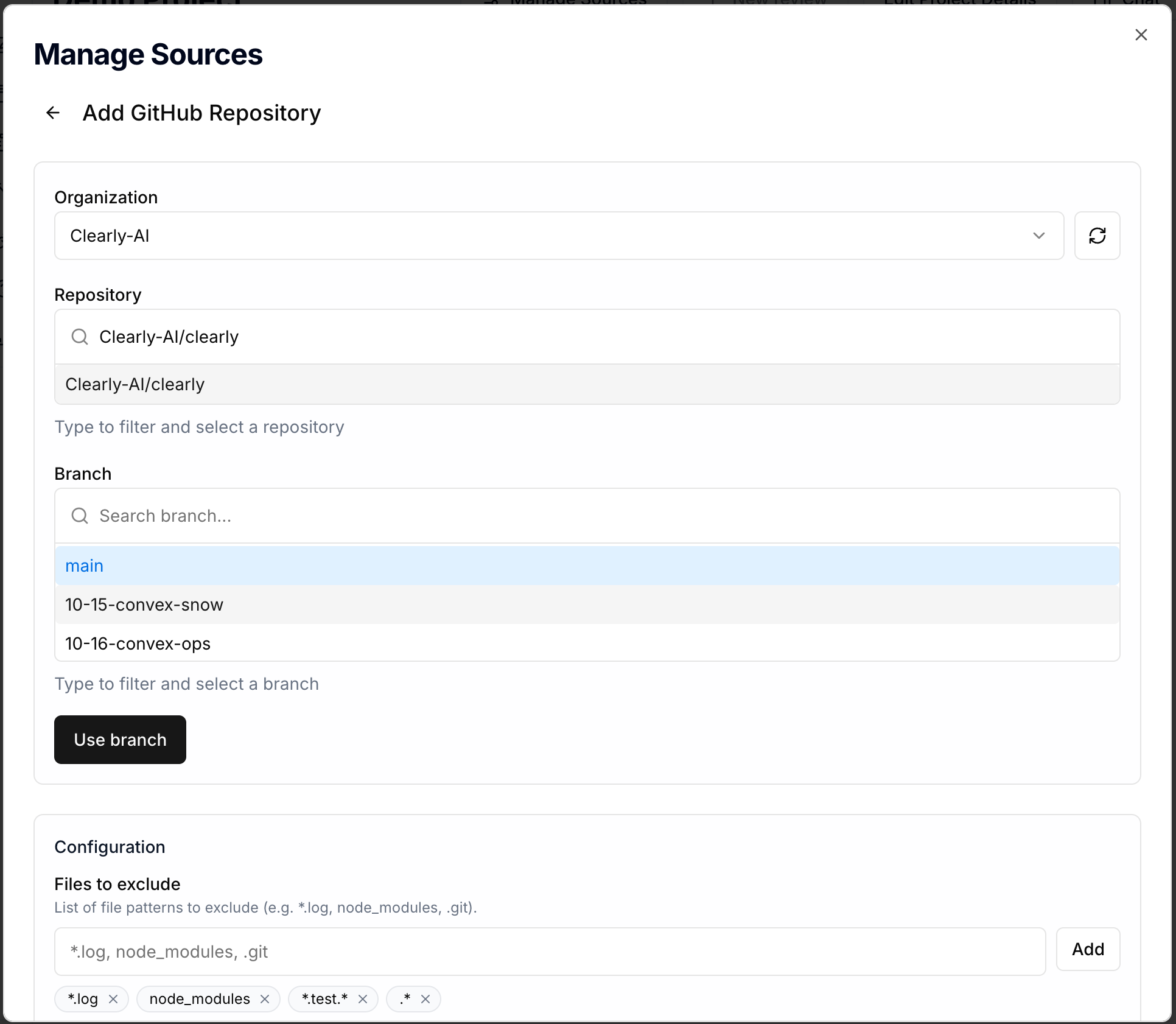
If the source is large, narrow the selection where the connector allows it. Code repository sources can include or exclude file patterns.
Connector setup
- GitHub: OAuth 2.0 or Personal Token
- GitLab: Personal Token
- Azure Repos: Personal Token
- Bitbucket: Personal Token
- Jira: Personal Token
- Azure DevOps Work Items: Personal Token
- Linear: OAuth 2.0 or Personal Token
- ServiceNow: OAuth 2.0 client credentials
- Archer IRM: Personal Token, set up with the Clearly AI team
- OneTrust: OAuth 2.0 client credentials
- Snyk: Personal Token
- Wiz: OAuth 2.0 client credentials
Related
- Notion - Connect Clearly AI to Notion using OAuth
- SharePoint - Connect Clearly AI to SharePoint using OAuth
- Workflows - Trigger Reviews and send results back to connected tools